Sunday, February 9, 2020

Pain and Glory: movie review

Almodóvar's Still Got the Mojo


No one puts exuberance on the screen quite like Pedro Almodóvar. Since his earliest studio films in the 1980s, his signature style has involved saturated color, elaborate compositions, and vivacious performances. In his latest film, Pain and Glory, the Spanish director brings his familiar panache to a contemplative and melancholy story that feels like a very personal account of the terrors of getting older. Can we still be the innocent souls we once were?

Centered on a celebrated but aging director of candy-colored art films, Salvador Mallo (Antonio Banderas) could be a dopplegänger of Almodóvar himself with his burst of grey hair and colorful clothes. Salvador is sad-eyed and whispery even in the midst of his artful surroundings and gorgeous leather coats, and he quickly makes clear why: his physical ailments are so overpowering that he's lost the connection to his creativity. His back aches, he can't sleep, and his throat is so constricted that taking a sip of water is enough to set off a coughing jag that will halt all conversation. With so much pain in his body, there seems to be no room for expression in his soul.

And yet, we know that soul must still brim with it. An early scene shows an idyllic glimpse of his childhood as he hung on his mother's back when she washed clothes by the river while singing flamenco melodies with the other village women. Scenes from Salvador's childhood give us glimpses of the days when he lived in a village of whitewashed caves with his mostly absent father and his doting but domineering mother (Penelope Cruz). These scenes feel like crystallized memories, centering on moments of insight, desire, and refuge for the bookish boy. Crosscut with the present-day Salvador, the childhood memories emphasize the gulf between the inspiration that once moved him and the emptiness of his current world.

Of course, we want Salvador to get his mojo back, but Almodóvar hasn't given us a simple redemption story. Various incidents get Salvador engaging with the world again, from reconnecting with an old actor friend to acquiring an amateur heroin habit that seems to both relieve his pain and provide a connection to evocative childhood memories. An encounter with a long-lost lover proves tender and edifying, but none of it seems to be a magic key to chasing away his funk. There's no secret door out of depression, the film seems to say, other than just getting through each day.

Asier Etxeandia, Pedro Almodóvar, Antonio Banderas
Antonio Banderas, in some of Almodóvar's earlier films, was a golden Adonis with matinée idol looks and the kind of sex appeal that rocketed him to Hollywood stardom in the '90s. Now in his late fifties, Banderas gives a restrained but focused performance that makes great use of his whisper-purr of a voice and soulful eyes to communicate Salvador's malaise. Despite his slow, stiff-backed walk and coughing spasms, Banderas's vitality suggests that Salvador's main problem may lie less in his body than in his mind. If he can just clear his head enough to fix his attention on the right idea, he might be able to make another film.

I hope Pedro Almodóvar makes many more films, and that his creative evolution continues to mine his inimitable style for more introspective films like this one. Yet a final, poignant scene offers what could be an apt coda for Almodóvar's entire career, transmuting the colors and emotions of youthful memories into cinema. The pain will always be there, he seems to be saying, but through art we can turn it into something like glory.

Friday, January 17, 2020

Little Paw in Infinite Worlds

A stand-alone excerpt from my novel-in-progress was just published in Infinite Worlds Magazine, and I couldn't be happier with how great this publication looks. The issue is gorgeous, with slick, full-color, full-page bleed images of work from contemporary sci-fi and fantasy illustrations by an international roster of artists. I'm honored to have my work included. It's especially amazing to see the image that the artist Johan Aberg came up with to accompany my story. Details elements drawn from the text appear in the image: the raggedy teddy bear floating in space outside the porthole; the dying woman huffing oxygen through a tube; the interior of the greenhouse module with its instrument panel. It's a rush to see my work on the page, illustrated so beautifully. It's not available online so order a copy of this outstanding literary and art journal from the website's store today!


Thursday, December 19, 2019

Book Review: November Road, by Lou Berney

While watching Martin Scorcese’s 15-hour epic The Irishman, I kept wishing that I was watching the (as-yet-unmade) film of Lou Berney’s November Road. The two stories share the setting and macho posturing of 1960s-era mafiosos, but Berney’s story is far more personal and engaging. The story unwinds in the immediate aftermath of the Kennedy assassination in Dallas, 1963. We come to understand that our protagonist was a small cog in the wheels of the mafia machine that killed the president, and he himself is only beginning to understand what he has been a part of. When he realizes that everyone involved is getting whacked, he has to get out of town fast. With a killer on his tail, he stumbles upon a young divorcée and her two little girls. First he ingratiates himself, then he starts falling in love. The little family is a perfect cover for him--but he’s putting everyone at risk just by sticking around. If they can get to JFK, they can certainly get to him.
An old friend, Dave Medicus, puts out a fantastic podcast about books, The Inside Flap. Here's the episode where he interviews Lou Berney and finds out what the biggest rush of the author's life has been. (It has something to do with Stephen King.)

Saturday, December 14, 2019

2019 Publications Round-up

In 2019, I received 96 rejections from literary magazines. These eight stories were accepted:

  1. Always Running (Stain'd)
  2. Cities of the Future (Suspect Press)
  3. Satellite Presence (Retreat West)
  4. Running Bear (F(r)iction)
  5. Circle of Blazers (Chaleur)
  6. Cloudscape (The Ghost Story)
  7. Love and Death Under the Rain (Red Rock Review)
  8. Little Paw (Infinite Worlds)
While I'm proud of all these publications, I'm not really sure what the point is in continually polishing my work and sending it out into the world. Despite eight successes, I'm still wearing the same shirts and driving the same car and going to bed at the same time every night. Rejection hasn't wrecked me, but acceptance hasn't affected me much, either. Some of the above publications are beautiful to hold in my hands--F(r)iction in particular is a gorgeous magazine--and I'm honored to have my work find a place in all their pages. And yet--so what? A few people, here and there, have presumably read my stories, but their reactions are unknown to me beyond a few thumbs-up on social media. Do they make it through to the last line? Do their eyes go still as they make some inner connection? Or do they skim a few paragraphs and move on? 

But it's worth remembering that I'm not really writing for that unknowable audience. I'm writing for a few close friends, and for myself, and I'd keep doing it even if I never get another acceptance. Although it would be nice to be able to splurge on some new shirts at some point. Bring it on, 2020. 

Saturday, November 23, 2019

Notes on Social Media Cleanse

I did a Facebook blackout for a week, and ended up completely forgetting about the place—it was wonderful!
As a writer/musician, it’s not realistic for me to delete my account and walk away permanently—90% of the Indiegogo fundraising we did for our Firstimers debut album came from our heroic FB contacts. In the future, I hope to be able to entice some my social media friends into reading my novel, if it ever gets published. I know some brilliant people on FB, whose opinions I value, and I don’t want to lose those connections.
But walking away for a week felt great. The first hour was the hardest, when my thumb automatically opened the FB app on my phone several times like some kind of Pavlovian ingrained behavior. So I shifted the app onto another screen, buried among unused apps, and immediately forgot about it.
After a few days, I started getting a lot of FB emails: So-and-so posted a picture, somebody else replied to an event, whatever—which tells me that the algorithm noticed that I was inactive and wanted to pull me back in. That felt like a tiny victory. The best part is, when the week was finally over, I forgot to log back in. The app was no longer in its usual place, and my thumb had broken the habit of tapping it. I’m a few days late with this summary because of that. For those of you struggling with (a) the addictive nature of Facebook, and/or (b) the collusion of Facebook with white supremacy, right wing politics, and conspiracy-mongering, I highly recommend a week-long cleanse. You can come back, we’ll still be there. Where else can we go?

Sunday, November 10, 2019

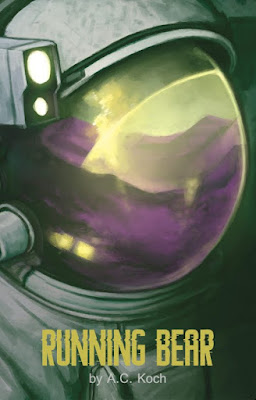
RUNNING BEAR

What is the future of humanity? Can we survive our current dangerous flirtations with climate change and nuclear war? Do we even deserve to?

RUNNING BEAR tells the story of an ambitious project to design a mission capable of transporting a thousand highly-skilled humans to colonize another solar system, carrying along an Archive of everything that makes humanity worth saving--art, literature, cinema, poetry, and of course, science.

The story takes place over three interwoven time frames: Oscar Running Bear and his team of astronauts and scientists as they make their final preparations in the BioDome in the Nevada desert before ascending into orbit; Oscar's first conversations with the eccentric billionaire who's bankrolling the mission; and Oscar's troubled childhood on the Navajo reservation where he grew up. These three timelines collide in a bleak ending that seems to snuff out all hope for the mission and for humanity--and yet a few threads of hope remain.

RUNNING BEAR was awarded F(r)iction Magazine's Short Story Award in the spring of 2019, and has just been published online in issue #14--the Survival Issue. If you like what you read, rejoice: the story doesn't end here. In fact, this is just the opening chapter in a longer and more involved story, also titled RUNNING BEAR, which carries the story of the mission (and some of the same characters) much farther into the universe.

Art by Enrica Angiolni

Saturday, November 2, 2019

Le Singe


Le Singe (2012)


Il ne faut jamais voir le singe dans les yeux--jamais!


Filmed with Gavin Dunnet's spooky-ass postcard. Seriously--don't look at it.